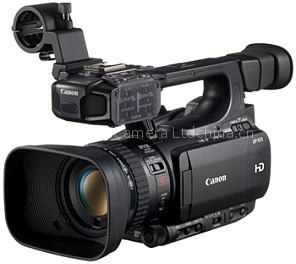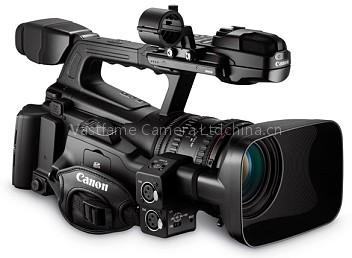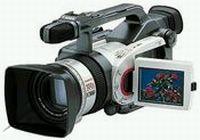
Indonesia Camera GL1 is a Video Cameras product. Key specs — Origin: Indonesia.
Product Description
Specifications: Canon, more than any other manufacturer of still and video cameras, has listened carefully to the market, and they\'\'ve heard what professionals want and need. Considering the time lapse between estimating what we want, and being able to deliver it to us when we want it--their efforts have been exceptional.
Eighteen months ago, we reviewed the Canon XL-1 camcorder. It was, and remains, the premier tool for serious videojournalists. It\'\'s batting average, going up against $50,000 plus Betacams for broadcast use, has been phenomenal. In the months ahead, you can expect an improved version of this camera, which will only solidify Canon\'\'s lead.
In the meantime, for those professional photojournalists who wanted to add digital video to their toolbox, the big problem has been the sheer size of the instrument.
As wonderful as the XL-1 is, it\'\'s still tough to imagine a photojournalist carrying their normal complement of cameras, lenses, and all the other stuff they need for daily coverage, then adding a video camera. What we need is a camera small enough to tuck into a camera bag, but still able to deliver broadcast quality(whichmeans using a 3 CCD camera).
The GL-1 is aimed at this market. At 3 5/8 lbs. It can easily be stowed in a Domke bag, along with the strobe and meters. Yet, its operating capability is broadcast quality. It has a flip-out 2.5 LCD screen that offers wonderful options.
It takes standard Mini DV cassettes, and in our tests, it is hard to tell the difference between tape shot on the XL-1 and the Gl-1. For any serious videojournalist, you must take into account a simple proposition: All prosumer cameras are very likely to fail.
There is a difference between the robustness of a Betacam and the best DV cameras on the prosumer level. They WILL fail, and per Murphy\'\'s Law, they will do it at the worst possible time. On a shoot for ABC News Nightline, my XL-1 blew a main power chip halfway through the shoot, and I was on the island of Capri.
Fortunately, I was able to borrow a PAL mini-DV to finish the shoot, but it taught me a lesson. The camera uses the same batteries as the XL-1, and by using the PRO lithium-ion 2700mAh battery, I was able to run through almost a full hour of tape without replacement. The camera uses 3 1/4 inch chips each delivering 250,000 effective pixels.
This is opposed to the three 1/3 inch chips in the XL-1. There are two major problems with the camera, however. The first, is in the field of audio. The dinky onboard mic simply won\'\'t cut it for broadcast use. When interviewing a subject, on the street, at a distance of three feet, the audio quality is not up to broadcast specs.
Strangely enough, Canon has the capability to come up with a fix. Which brings us to a reality facing manufacturers, whether they are in the camera or computer industry.